
Chronological Age in Psychological and Developmental Testing
Chronological age may be required in some psychological, developmental, speech-language, and cognitive assessments. In these situations, age is calculated from the person’s date of birth to the relevant testing date.
The exact age may be used when an assessment has age-based administration instructions, normative groups, or scoring procedures. However, the role of chronological age differs between tests, so the instructions for the specific assessment should always be followed.
Why Chronological Age May Matter in Psychological Testing
Some psychological and developmental assessments use age-specific instructions or normative information. Depending on the test, chronological age may help professionals:
- Select the appropriate age range or normative group.
- Follow age-specific administration instructions.
- Record the examinee’s age accurately.
- Interpret results using the appropriate reference information.
Chronological age does not by itself determine a diagnosis, developmental level, or test outcome. Results should be interpreted according to the assessment’s official guidance and the relevant professional context.
How Is Chronological Age Calculated for Testing?
Chronological age for testing is calculated by comparing two dates:
- Date of Birth
- Testing Date
The difference between these dates gives the person’s calendar age, commonly expressed in years, months, and days.
The testing date is important because chronological age should reflect the person’s age when the assessment is administered, unless the test instructions specify another reference date.
Worked Example
Date of Birth: 15 March 2015
Testing Date: 26 August 2026
Chronological Age: 11 years, 5 months, and 11 days
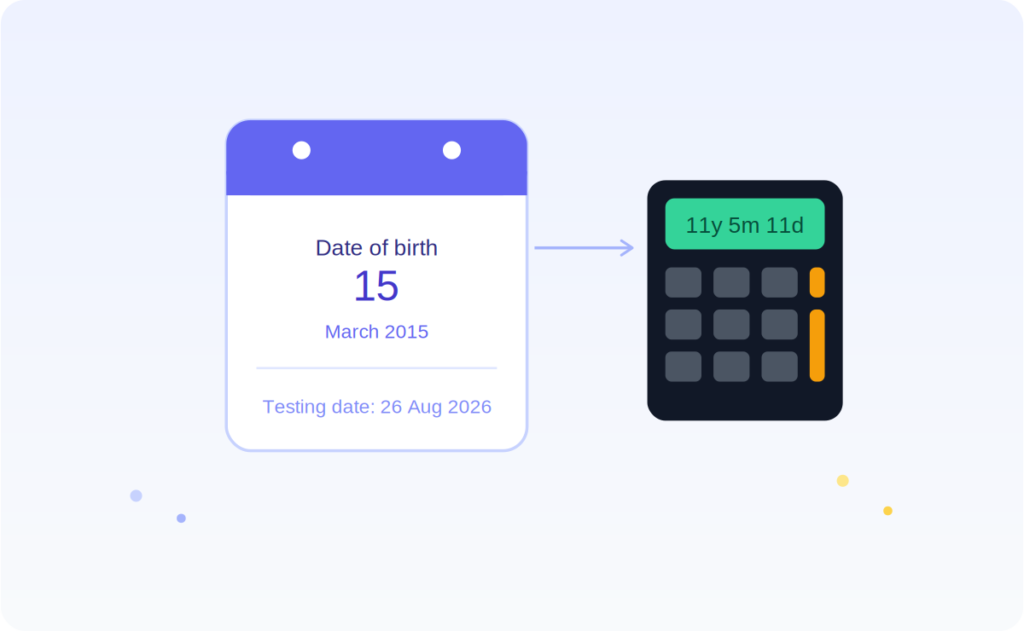
Although the calculation can be performed manually, an online chronological age calculator can simplify the date comparison and reduce routine calculation errors.
What Chronological Age Can—and Cannot—Tell You
Chronological age tells you how much calendar time has passed between a person’s date of birth and the testing date.
Depending on the assessment, this age may be used to select an age range, normative group, or administration procedure.
However, chronological age alone does not measure intelligence, developmental maturity, language ability, emotional development, or academic performance. Two people of the same chronological age can perform very differently on the same assessment.
The meaning of a test result should therefore be determined from the assessment’s official scoring and interpretation guidance rather than from chronological age alone.
Chronological Age and Age-Based Norms
Some psychological and developmental assessments compare a person’s performance with a reference group of people of a similar age. These are often called age-based norms.
In such assessments, entering the correct date of birth and testing date can be important because the examinee may need to be placed in a specific age band.
Not every test uses age in the same way. Some may use broad age groups, while others may provide more specific rules in the administration or scoring manual.
For this reason, chronological age should be calculated accurately, but the assessment manual should determine how that age is actually used.
Important Points When Calculating Age for Testing
- Enter the complete and correct date of birth.
- Use the actual testing date unless the assessment specifies another reference date.
- Check the day, month, and year carefully.
- Use the age format required by the assessment.
- Do not round the age unless the test instructions specifically require it.
- Follow any special age-calculation rules provided by the test publisher.
Calculate Chronological Age for a Testing Date
If you need to compare a date of birth with a specific testing date, you can use our Chronological Age Calculator to obtain the general calendar difference in years, months, and days.
For standardized testing, always check whether the assessment publisher requires a particular method for calculating or recording chronological age.
Frequently Asked Questions
What is chronological age in psychological testing?
Chronological age is the amount of calendar time between a person’s date of birth and the relevant testing date. Depending on the assessment, it may be recorded in years, months, and days.
Why is the testing date important?
The testing date determines the person’s chronological age at the time the assessment is administered. Using today’s date instead of the actual testing date could produce a different age.
Is chronological age the same as developmental age?
No. Chronological age measures time since birth, while developmental age describes a person’s level of development in particular areas. A person may perform above or below what is typical for their chronological age.
Can chronological age determine a psychological diagnosis?
No. Chronological age alone does not establish a diagnosis or determine a person’s cognitive, emotional, language, or developmental abilities. Assessment results should be interpreted according to the test’s official guidance and relevant professional standards.
Should chronological age be rounded for testing?
Do not automatically round it. Use the age-calculation and recording method specified by the assessment publisher.
Conclusion
Chronological age can play an important role in psychological and developmental testing when an assessment uses age-based norms, administration rules, or scoring procedures. The age should be calculated from the complete date of birth to the relevant testing date rather than estimated from the birth year alone.
However, chronological age is only one piece of information used in assessment. It does not by itself describe a person’s intelligence, developmental level, language ability, or psychological condition. For formal testing, the calculation and interpretation procedures provided by the assessment publisher should always take priority.