
How to Calculate Age Difference Between Two People
Finding the age difference between two people is easy when their birthdays fall on the same day and month. It becomes less straightforward when the dates fall in different months, involve leap years, or require an exact answer in years, months, and days.
The most accurate method is to compare the two complete dates of birth rather than simply subtracting one birth year from the other.
In this guide, we’ll show how to calculate an age difference manually, explain where mistakes usually happen, and provide examples you can follow.
If you only need the answer, you can use our Age Difference Calculator to compare two dates instantly.
I’ve noticed this tool gets used for a lot more than people expect. It’s not just idle curiosity about who’s older between two friends.
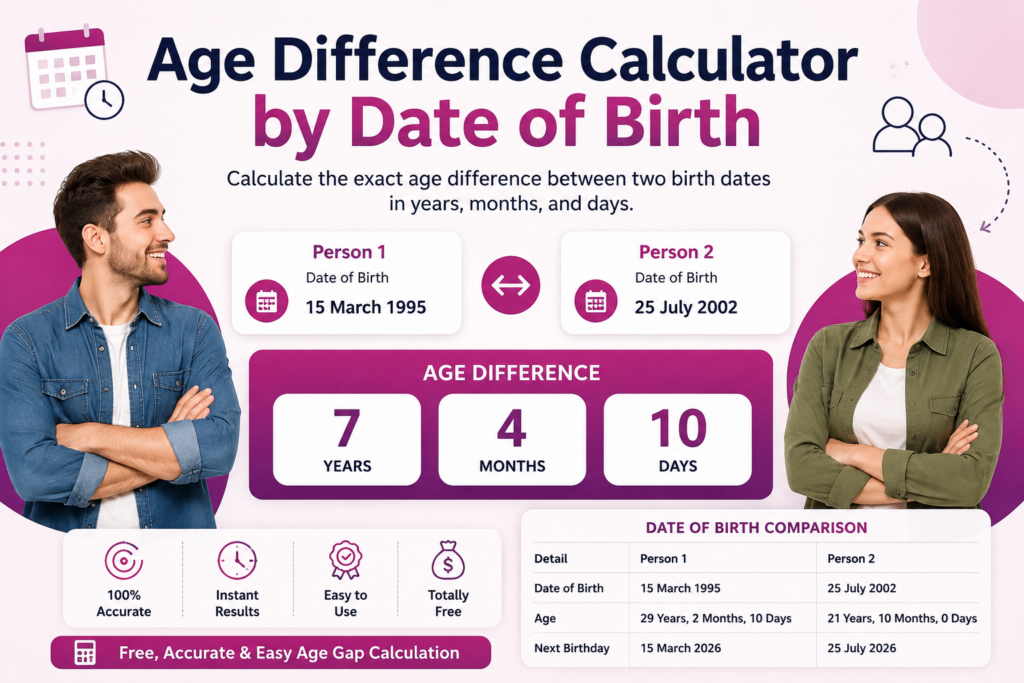
How to Calculate Age Difference Between Two People Manually?
To calculate the exact age difference between two people, compare their complete dates of birth rather than subtracting only the birth years.
Start with the earlier date and subtract it from the later date in three parts: days, months, and years.
1. Compare the days.
If the later date has a smaller day number, borrow the number of days from the previous month.
2. Compare the months.
If the later month is smaller than the earlier month, borrow one year and add 12 months.
3. Compare the years.
After any necessary borrowing, subtract the earlier birth year from the later one.
The final result gives the age gap in years, months, and days. Because January falls before March in the calendar year, the actual gap is 6 years, 9 months, and 18 days.
Example
Person A: 15 March 1998
Person B: 2 January 2005
The exact difference is:
6 years, 9 months, and 18 days
Simply calculating 2005 − 1998 = 7 would be misleading because Person B’s January birthday falls before Person A’s March birthday.
When Is an Age Difference Calculation Useful?
Use:
Comparing two dates of birth can be useful in many everyday situations. You may want to find the exact age gap between:
- Siblings or other family members
- Partners or friends
- Two people in family-history or genealogy records
- Children born in the same year
- Any two people whose birthdays fall in different months or years
An exact calculation is especially useful when the difference cannot be understood accurately by comparing birth years alone.
Age Difference Examples
These examples show how the exact difference changes depending on the day, month, year, and leap-year dates involved.
| Person A – Date of Birth | Person B – Date of Birth | Age Difference (Years, Months, Days) |
|---|---|---|
| 10 January 1990 | 22 June 1990 | 0 years, 5 months, 12 days |
| 5 March 1985 | 5 March 1990 | 5 years, 0 months, 0 days |
| 28 February 2000 | 1 March 2000 | 0 years, 0 months, 2 days |
| 15 August 1995 | 3 April 2001 | 5 years, 7 months, 19 days |
| 1 December 1978 | 29 February 1996 | 17 years, 2 months, 28 days |
| 20 July 2010 | 20 July 2022 | 12 years, 0 months, 0 days |
| 9 September 1965 | 30 November 1999 | 34 years, 2 months, 21 days |
Notice the third row especially — one day apart, but it crosses a leap year boundary, which is exactly the kind of edge case that trips up manual math.
Using an Age Difference Calculator by Date of Birth, you can easily compare two birth dates and see the difference in years, months, and days.
Doing It By Hand vs. Letting a Calculator Handle It
Manual Calculation vs Online Calculator
| Feature | Manual Calculation | Online Calculator |
|---|---|---|
| Method | Dates are subtracted manually using years, months, and days. | Complete dates are compared automatically. |
| Speed | Takes more time, especially for complicated dates. | Provides the result almost instantly. |
| Accuracy | Depends on correct borrowing and calendar calculations. | Automatically handles calendar calculations. |
| Leap Years | Must be considered manually. | Handled automatically by the calculator. |
| Best Suited For | Learning how age difference calculations work. | Quick exact-date comparisons. |
Common Mistakes When Calculating an Age Difference
- Subtracting only the birth years: This ignores whether each birthday has already occurred.
- Ignoring month lengths: Calendar months contain 28, 29, 30, or 31 days.
- Forgetting leap years: February 29 can affect exact date differences.
- Borrowing incorrectly: When the later day or month is smaller, the calculation needs to be adjusted.
- Mixing date formats:
DD/MM/YYYYandMM/DD/YYYYcan easily be confused.
Calculate the Age Difference Online
If you prefer not to calculate the dates manually, enter both dates of birth into our Age Difference Calculator. The tool compares the complete dates and displays the difference in years, months, and days
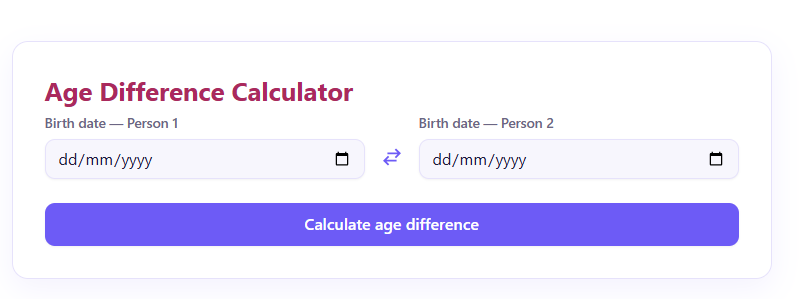
If the tool asks which date came first, double-check you’ve got that right. Swap the two dates and the size of the gap should stay identical; only which person is “older” changes.
Questions People Tend to Ask
How do you calculate the age difference between two people?
Compare the complete dates of birth, including the day, month, and year. Subtract the earlier date from the later date to get the exact difference in years, months, and days.
Why is subtracting birth years not always accurate?
Subtracting only the years ignores whether each person’s birthday has already occurred. Two people born in different months may have an age gap that is smaller than the difference between their birth years.
Can leap years affect an age difference calculation?
Yes. Leap years add an extra day in February, which can affect exact calculations involving February 29 or dates around the end of February.
Can I calculate the age difference automatically?
Yes. You can use our Age Difference Calculator to enter two dates of birth and get the exact difference automatically.
Conclusion
Calculating the age difference between two people requires more than simply subtracting their birth years. For an exact result, the complete dates, including the day, month, and year, should be compared.
Manual calculation is useful for understanding how the process works, while an online calculator can make the same comparison much faster. Whichever method you use, working with complete dates helps avoid common errors caused by different month lengths, birthdays, and leap years.