
Chronological Age vs Developmental Age: What’s the Difference?
Understanding chronological age vs developmental age can help parents, teachers, and caregivers better understand the difference between a child’s actual age and developmental progress.
These two ages may be similar, but they are not always the same. Understanding the difference can be useful for parents, teachers, and anyone involved in a child’s learning and development.
What Is Chronological Age?
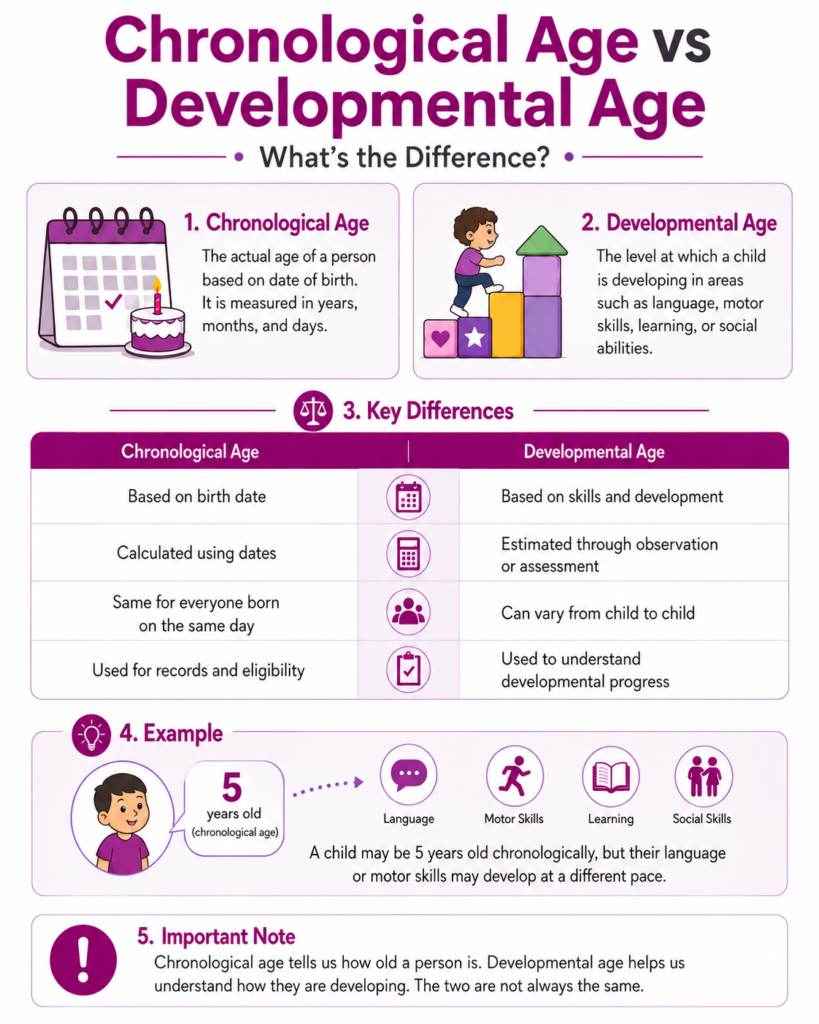
Chronological age is the actual amount of time that has passed since a person was born.
It is calculated from the date of birth to a selected date, which may be today or another reference date.
For example, if a child was born on 10 March 2020 and the reference date is 10 March 2026, the child’s chronological age is exactly:
6 years
If the dates do not fall on the same day and month, the age can be written more precisely in years, months, and days.
The basic formula is:
Chronological Age = Reference Date − Date of Birth
Chronological age is fixed by calendar time. It does not change according to a person’s abilities, health, learning speed, or physical development.
What Is Developmental Age?
Developmental age describes how a child is functioning in a particular area compared with typical developmental expectations.
For example, a child who is 6 years old chronologically may show language or motor skills that are more commonly seen in children of a different age.
Development can be considered in areas such as communication, movement, social interaction, problem-solving, learning, and everyday skills.
Unlike chronological age, developmental age is not simply calculated from dates. It is usually estimated through observation, developmental screening, or formal assessment.
The following comparison makes chronological age vs developmental age easier to understand at a glance.
Chronological Age vs Developmental Age
The main difference is simple:
| Chronological Age | Developmental Age |
|---|---|
| Based on date of birth | Based on development or functioning |
| Calculated using calendar dates | Estimated through observation or assessment |
| The same regardless of ability | May differ across developmental areas |
| Expressed in years, months, and days | Often described in relation to developmental milestones |
| Used for age records and eligibility | Used to understand development and support needs |
Chronological age answers:
“How old is the child?”
Developmental age is closer to:
“At what developmental level is the child functioning in a particular area?”
A Simple Example
Suppose a child is exactly 5 years old according to their date of birth.
That is the child’s chronological age.
During an assessment, the child may show communication skills similar to those often seen around age 4, while their motor skills may be closer to the expected level for age 5.
This does not mean the child has one single developmental age. Development can vary from one area to another.
That is why developmental age should be understood as an estimate related to specific skills rather than a replacement for chronological age.
This example shows why chronological age vs developmental age should not always be treated as the same measurement.
Why Can Chronological and Developmental Age Be Different?
Children do not all develop at the same pace.
One child may learn to speak earlier, while another may develop physical coordination more quickly. Some children may need additional time or support in certain areas.
Development may be influenced by many factors, including learning opportunities, environment, individual differences, and health or developmental conditions.
For this reason, two children with the same chronological age can show different levels of development.
Why Is Chronological Age Important?
Chronological age is commonly used when an exact age is required.
It may be relevant for school admission, examinations, official documents, age eligibility, forms, and educational records.
It is objective because it depends only on the person’s date of birth and the chosen reference date.
If you need an exact result, a Chronological Age Calculator can calculate age in years, months, and days without doing the subtraction manually.
Why Is Developmental Age Important?
Developmental information can help adults understand how a child is progressing in different areas.
For example, teachers may use developmental information when planning learning activities. Parents may use it to better understand milestones. Professionals may use assessments to identify areas where a child is doing well or may need additional support.
However, developmental age should not be treated as a diagnosis by itself.
A child’s development is more complex than a single number, and formal developmental concerns should be discussed with an appropriately qualified professional.
Is Developmental Age the Same in Every Area?
Not necessarily.
A child may develop at different rates in different areas.
For example, a child may have strong language skills but still be developing fine motor skills. Another child may be physically confident but need more time with communication or social skills.
Because of this, developmental assessments often look at several areas separately rather than assigning one overall developmental age.
Is Chronological Age More Accurate?
Chronological age is more precise in terms of calendar time because it can be calculated exactly from dates.
For example:
7 years, 4 months, and 12 days
Developmental age is different because it is an estimate based on skills, observations, or assessment results.
So the two measurements are used for different purposes and should not be compared as though one is “better” than the other.
Can Developmental Age Be Higher Than Chronological Age?
Yes, in some areas a child may demonstrate skills that are more advanced than those typically expected for their chronological age.
Likewise, a child may show skills that are developing more slowly in another area.
This is another reason developmental age should be considered in context rather than treated as a fixed label.
Chronological Age and Developmental Milestones
Developmental milestones are skills that many children reach around certain ages.
Examples include learning to walk, speaking words, following instructions, interacting with others, and performing everyday tasks.
These age ranges are useful guides, but children do not all reach every milestone on exactly the same day or month.
Chronological age provides the child’s actual age, while developmental milestones provide a general reference for understanding progress.
What is the main difference between chronological age vs developmental age?
Chronological age is based on the date of birth, while developmental age reflects a child’s level of development in specific areas such as language, movement, learning, or social skills.
Which Age Is Used for School Admission?
Schools normally use chronological age when they have an age requirement or cut-off date.
For example, if a school requires a child to be 5 years old by 1 September, the child’s date of birth is compared with that date.
Teachers or other professionals may still consider developmental information when planning support, but it does not usually replace the official age requirement.
Can I Calculate Developmental Age With an Online Age Calculator?
No. A normal age calculator can calculate chronological age because it only needs dates.
You can’t accurately calculate developmental age by simply entering a date of birth.
It usually requires information about a child’s skills and development, and in some situations a formal assessment may be needed.
A Chronological Age Calculator should therefore be used for exact calendar age, not for estimating developmental ability.
Frequently Asked Questions
Is chronological age the same as developmental age?
No. Chronological age is based on the amount of time since birth, while developmental age relates to a person’s developmental level in a particular area.
Can a child’s developmental age be lower than chronological age?
Yes. A child may show skills that are developing at a different pace from those commonly expected for their chronological age.
Can developmental age be higher than chronological age?
Yes. Some children may demonstrate advanced skills in particular areas.
How do I calculate chronological age?
Subtract the date of birth from the reference date. For an exact result, calculate the difference in years, months, and days.
Can developmental age be calculated from date of birth?
No. Date of birth is enough to calculate chronological age, but developmental age requires information about skills and development.
Conclusion
Chronological age and developmental age describe two different things.
Chronological age tells us exactly how much time has passed since a person was born.
Developmental age gives an idea of how a child is functioning in a particular area of development.
A child’s chronological age is fixed by calendar time, while development can vary between children and even across different skills in the same child.
For exact calendar age, use a Chronological Age Calculator. For questions about a child’s development, observations and appropriate professional assessment provide much more useful information than age calculation alone.