
Corrected Age vs. Chronological Age: What’s the Difference (and Why It Matters)
If you’ve had a baby who arrived early, you’ve probably already heard two terms thrown around at checkups: chronological age and corrected age. They sound like they should mean the same thing. They don’t, and the difference matters, especially in those first couple of years.
Here’s the simplest way to think about it: chronological age is how long your baby has actually been alive. Corrected age is what that number looks like once you account for how early they showed up.
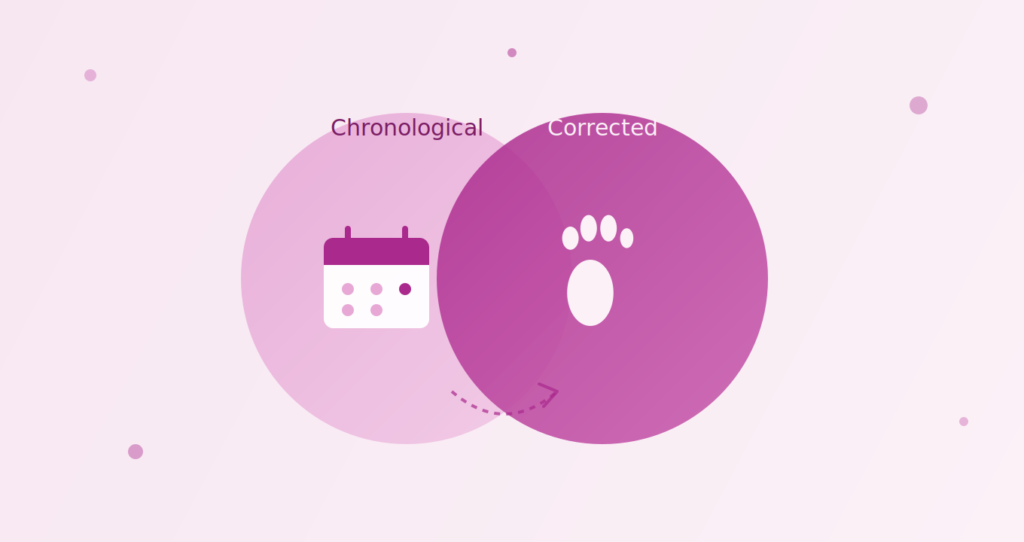
Chronological Age: The Straightforward One
This one’s easy; it’s just the time since birth, full stop. No adjustments, no asterisks.
Say your baby was born February 1st, and it’s now June 1st. That baby is four months old, chronologically. Doesn’t matter what the due date was or how early or late the baby arrived the clock started ticking the moment they were born.
You can express it in days, weeks, or months, and it’s basically the answer to the question everyone asks when they meet your baby: “How old is she?”
The math: Reference Date − Date of Birth = Chronological Age
Corrected Age: The One That Accounts for Prematurity
This is where things get more nuanced. Corrected age exists mainly for babies born prematurely, and instead of just measuring time since birth, it asks: how old would this baby be if we measured from their due date instead?
Say a baby arrived eight weeks before their due date. Calendar-wise, they might be five months old right now — but subtract those eight weeks, and you get a different number, one that can make more sense when you’re comparing where they’re at developmentally.
It’s important to be clear about what this isn’t: it’s not a second birthday, and it’s not some official “real” age. It’s just a different lens for looking at development during those early months.
The math: Corrected Age = Chronological Age − Weeks Born Early
Walking Through an Example
Let’s say a baby was born at 32 weeks. Full-term pregnancies run about 40 weeks, so:
40 − 32 = 8 weeks early
If that baby is now 24 weeks old chronologically:
24 − 8 = 16 weeks corrected
So you’ve got a baby who’s 24 weeks old by the calendar, but whose corrected age — the one that accounts for those two missing months in the womb — is 16 weeks.
A Real-World Version
Picture a baby whose due date was July 10th but who actually arrived on May 10th — two months early.
By November 10th:
- Chronological age: 6 months (that’s how long the baby’s been alive)
- Corrected age: roughly 4 months (accounting for the early arrival)
The baby isn’t secretly four months old. Six months is the real, actual age. Corrected age just adds context — a second data point, not a replacement for the first.
Side by Side
| Chronological Age | Corrected Age |
|---|---|
| Starts from actual birth date | Adjusts for prematurity |
| Answers “how long has the baby been alive?” | Answers “how old would the baby be at full term?” |
| Just needs a birthdate and today’s date | Needs to know how early the baby arrived |
| The baby’s real, legal age | A developmental reference point |
| Applies to every baby | Mainly relevant to babies born early |
Why Bother With Corrected Age at All?
Because a baby born eight or ten weeks early simply had less time developing in the womb than a baby born on time — and that gap doesn’t just disappear the day they’re born.
Picture two babies, both four months old on the calendar. One arrived right on schedule; the other showed up two months early. If you compare them purely by chronological age, you might expect them to be hitting the same milestones at the same time rolling over, tracking objects, babbling— when really, one of them has had two fewer months of development to work with.
Corrected age gives parents and doctors a more honest baseline for that comparison, particularly around things like motor skills, communication, sitting up, and crawling.
Does It Change the Baby’s Actual Birthday?
Nope. Never. If your baby was born on March 5th, March 5th is the birthday — full stop, cake and candles and all. Corrected age is a tool used in certain developmental conversations. It has zero bearing on your baby’s real date of birth.
Corrected Age vs. Developmental Age — Not the Same Thing
These two get mixed up sometimes, but they’re answering different questions.
Corrected age is purely about the math of prematurity — how early the baby arrived, adjusted against the calendar. Developmental age is about where a child actually is in a specific skill area, like language or movement.
A baby can have one chronological age, one corrected age, and then show developmental progress that varies from skill to skill — maybe ahead in one area, right on track in another. All three of these can tell a slightly different story at the same time.
How Long Do You Keep Using Corrected Age?
Generally, it matters most in the early years. As a child gets older, a few weeks or months of prematurity start to matter less relative to their overall age — the gap that felt significant at four months becomes almost irrelevant by age three or four.
Most pediatricians use corrected age for roughly the first two years for babies born prematurely, though this varies depending on how early the baby was and other individual factors. If you’re not sure whether it still applies to your child, that’s a great question for your pediatrician rather than something to guess at.
Can a Regular Age Calculator Handle This?
A standard Chronological Age Calculator just needs a birthdate and a reference date that’ll get you the answer easily enough.
Corrected age needs one more piece of information: either the due date or how many weeks early the baby was born. So unless a calculator is specifically built to handle prematurity, you’ll likely need to do that adjustment separately.
A Couple of Things People Get Wrong
“Corrected age replaces chronological age.” It doesn’t; they coexist, and both are useful in different contexts.
“My premature baby should hit every milestone exactly on corrected age schedule.” Not necessarily. Corrected age is a helpful reference point, not a guarantee. Every child develops on their own timeline, and age is only one piece of a much bigger picture.
If you have real concerns about your child’s growth or development, an online calculation isn’t a substitute for talking to a pediatrician or developmental specialist.
Quick Answers
What’s the core difference? Chronological age counts from the actual birth date. Corrected age adjusts that number based on how early the baby arrived.
Is corrected age a second birthday? No, the real birthday never changes.
How do I calculate it? Subtract the number of weeks (or months) the baby was born early from their chronological age.
Does this apply to all babies? No, mainly babies born significantly before full term.
Can corrected age and developmental age differ? Yes, one’s about prematurity, the other’s about actual skills and progress.
At the end of the day, both numbers have their place. Chronological age tells you how long your baby’s been in the world. Corrected age gives you a bit of extra context for those early developmental comparisons. Neither one replaces the other, and if you ever have real questions about your baby’s growth, your pediatrician is always the better resource than a calculator.
If you want the exact number, our Chronological Age Calculator does the math for you in seconds.